Journals
-
Tanwirul Uqul: Jurnal Ekonomi dan Bisnis Islam
Tanwirul Uqul: Jurnal Ekonomi dan Bisnis Islam
Journal Initials : TUJEBIISSN : 2746-1017 (Online), 2746-1009 (Print)DOI Prefix : by Publisher : LPPM STEBIA BangkalanFrequency : BiannualPublishing Mode : Open AccessCitation Analysis : DOAJ | Google Scholar | Dimensions
Tanwirul Uqul: Jurnal Ekonomi dan Bisnis Islam is a peer-reviewed scholarly journal published by the Institute for Research and Community Service (LPPM) of the Al-Anwar College of Islamic Economics and Business (STEBIA) Bangkalan, Indonesia. The journal publishes original research articles and scholarly studies in Islamic economics and Islamic business, covering economic, financial, business, management, and related interdisciplinary perspectives. It aims to contribute to the advancement of knowledge and scholarly discussion in Islamic economics and business at national and international levels. Tanwirul Uqul is published twice a year, in March and September, and provides immediate open access to all published articles for academics, researchers, practitioners, and the general public. All submitted manuscripts undergo an initial editorial screening followed by a double-blind peer review process conducted by independent reviewers with relevant expertise.
High Quality Peer ReviewOpen Access for Wider ImpactGlobal ContributorsInterdisciplinary Perspectives -
Jurnal Studi Hukum Islam
Jurnal Studi Hukum Islam
Journal Initials : JSHIISSN : 2746-1017 (Online), 2746-1009 (Print)DOI Prefix : by Publisher : LPPM STEBIA BangkalanFrequency : BiannualPublishing Mode : Open AccessCitation Analysis : DOAJ | Google Scholar | DimensionsJurnal Studi Hukum Islam (Journal of Islamic Law Studies) is a peer-reviewed academic journal dedicated to the advancement of scholarly inquiry in the field of Islamic law and its contemporary applications. The journal serves as a platform for researchers, legal scholars, and academics to disseminate original research, critical analysis, and theoretical developments pertaining to Islamic jurisprudence and its relevance in modern legal discourse. The journal fosters intellectual exchange among scholars from diverse academic traditions, encouraging interdisciplinary approaches that bridge classical Islamic legal thought with contemporary legal, social, and policy frameworks. It upholds the highest standards of academic integrity, rigorous peer review, and scholarly excellence consistent with internationally recognized publication ethics. Jurnal Studi Hukum Islam is committed to open-access dissemination of knowledge, ensuring that research outputs are freely available to academics, practitioners, policymakers, and the general public without financial or institutional barriers. The journal adheres to the principles set forth by the Committee on Publication Ethics (COPE) and aligns its operational standards with the requirements of leading international indexing databases, including Scopus.
High Quality Peer ReviewOpen Access for Wider ImpactGlobal ContributorsInterdisciplinary Perspectives -
Al-Anwar Journal of Islamic Studies
Original title : Al-Anwar Journal of Islamic Studies Abbreviation : Al-Anwar Frequency : Biannually Number of articles per issue : 5–7 research articles and reviews per issue DOI : - ISSN : - Editor-in-Chief : Prof. Masdar Hilmy Publisher : STEBIA Bangkalan Citation Analysis : Google Scholar, Dimensions, Garuda Al-Anwar Journal of Islamic Studies is a peer-reviewed, open-access scholarly journal dedicated to the advancement of knowledge in the field of Islamic sciences and studies. The journal serves as a premier academic platform that bridges classical Islamic scholarship with contemporary intellectual discourse, fostering rigorous and interdisciplinary inquiry into the diverse dimensions of Islam. Established with the vision of nurturing a vibrant scholarly community, Al-Anwar is committed to publishing high-quality research articles, critical reviews, and theoretical contributions from academics, researchers, and practitioners across the globe. The journal welcomes submissions in English, Arabic, and Indonesian, reflecting its commitment to both global reach and local scholarly traditions. Al-Anwar Journal of Islamic Studies is published biannually and employs a rigorous double-blind peer-review process to ensure the integrity, originality, and scholarly merit of all published works. The editorial team comprises distinguished scholars from leading national and international institutions in the field of Islamic studies.
-
Journal of Interdisciplinary Islamic Studies
Original title : Journal of Interdisciplinary Islamic Studies Abbreviation : JoIIS Frequency : Biannually Number of articles per issue : 5–7 research articles and reviews per issue DOI : - ISSN : - Editor-in-Chief : Athaillah, Ph.D. Publisher : Sekolah Tinggi Ekonomi dan Bisnis Islam Al-Anwar Bangkalan Citation Analysis : Google Scholar, Dimensions, Garuda The Journal of Interdisciplinary Islamic Studies (JoIIS) is an international, peer-reviewed, and open-access academic journal devoted to advancing the critical and interdisciplinary study of Islam in its diverse global contexts. The journal serves as a platform for scholars, researchers, and practitioners to engage with contemporary debates and emerging paradigms in Islamic thought, education, culture, society, and civilization. This journal encourages rigorous intellectual dialogue that bridges traditional Islamic scholarship (turath) with modern scientific inquiry across disciplines such as education, sociology, anthropology, communication, psychology, law, politics, digital media, and environmental studies. It aims to illuminate how Islamic values, epistemologies, and worldviews intersect with broader social, cultural, and technological transformations in the modern world.
-
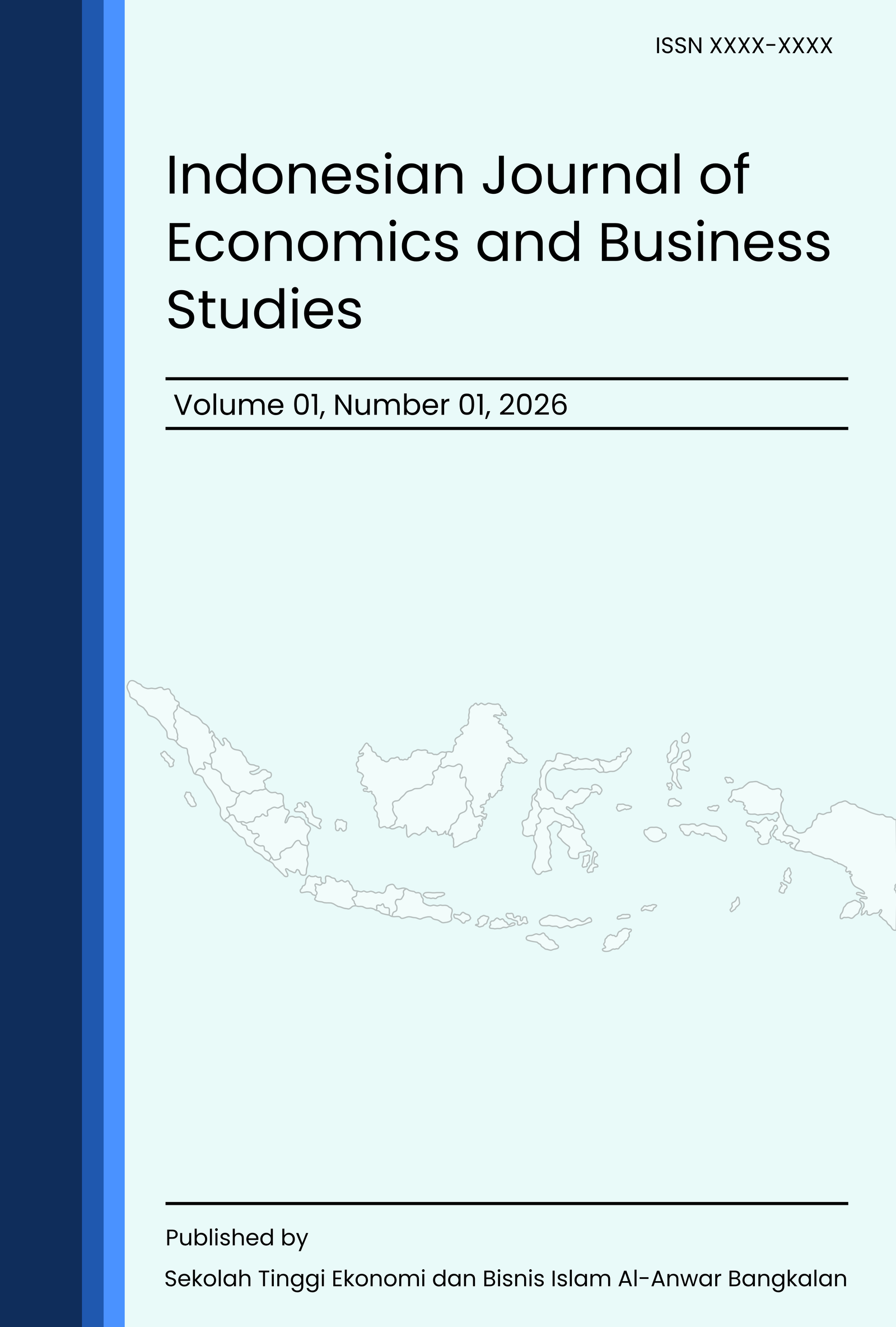
Indonesian Journal of Economics and Business Studies
The Indonesian Journal of Economics and Business Studies (IJEBS) is a peer-reviewed, open-access academic journal published biannually by the Sekolah Tinggi Ekonomi dan Bisnis Islam Al-Anwar Bangkalan. As a scholarly platform dedicated to advancing the frontiers of knowledge in economics, business, and management, IJEBS is committed to serving as a premier forum for the dissemination of original, rigorous, and high-quality research that reflects both academic excellence and real-world relevance.
Beyond its role as a publication venue, IJEBS strives to bridge the gap between academic inquiry and practical application, with a particular emphasis on the Indonesian economic landscape and the broader regional context of Southeast Asia. The journal actively promotes interdisciplinary dialogue, bringing together economists, business scholars, policymakers, and practitioners in a shared pursuit of evidence-based understanding. In doing so, IJEBS also fosters meaningful collaboration between researchers from Indonesia and the wider international academic community, enriching the scholarly conversation through diverse perspectives and cross-cultural engagement.
At its core, IJEBS is driven by a commitment to generating knowledge that matters — research that contributes to sustainable economic development, inclusive growth, and informed policy-making across Indonesia and the Southeast Asian region.
The journal welcomes a broad range of scholarly contributions, including original research articles, systematic review papers, and short communications. Topics of interest span across Economics (including macroeconomics, microeconomics, and development economics), Business and Management (encompassing strategy, organizational behavior, and entrepreneurship), Finance and Accounting (including Islamic finance, corporate finance, and auditing), as well as Emerging and Interdisciplinary Topics that reflect the evolving dynamics of the global economic landscape.